by Various
Available in 585 free installments
Owner:
The bond of an arch obtains its name from the arrangement of headers and stretchers on its soffit. The under side of an arch built in English bond, therefore, will show the same arrangement as the face of a wall built in English bond. If the arch is in Flemish the soffit presents the same appearance as the elevation of a wall built in that bond.
It is generally held that the building of wood into brickwork Plates. should as far as is possible be avoided. Wall plates of wood are, however, necessary where wood joists are used, and where these plates may not be supported on corbels of projecting brickwork or iron they must be let flush into the wall, taking the place of a course of bricks. They form a uniform bed for the joists, to which easy fixing is obtained. The various modes adopted for resting and fixing the ends of joists on walls are treated in the article Carpentry.
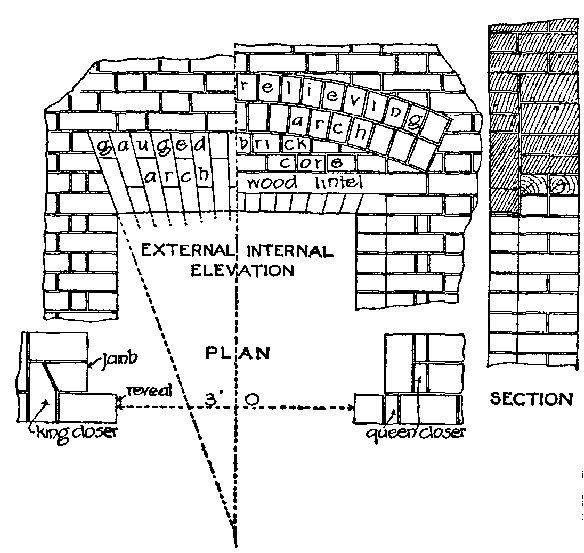 Fig. 15.
Lintels, which may be of iron, steel, plain or reinforced concrete, or stone, are used over square-headed openings instead of or in conjunction with arches. They are useful to preserve the square form and receive the joiners' fittings, but except when made of steel or of concrete reinforced with steel bars, they should have relieving arches turned immediately over them (Fig.15).
"Fixing bricks" were formerly of wood of the same size as the ordinary brick, and built into the wall as required for fixing joinery. Owing to their liability to shrinkage and decay, their use is now practically abandoned, their place being taken by bricks of coke-breeze concrete, which do not shrink or rot and hold fast nails or screws driven into them. Another method often adopted for providing a fixing for joinery is to build in wood slips the thickness of a joint and 4½ in. wide. When suitable provision for fixing has not been made, wood plugs are driven into the joints of the bricks. Great care must be taken in driving these in the joints of reveals or at the corners of walls, or damage may be done.
The name "brick-ashlar" is given to walls faced with ashlar stonework backed in with brickwork. Such constructions are liable in an aggravated degree to the unequal settling and its attendant evils pointed out as existing in walls built with different qualities of bricks. The outer face is composed of unyielding stone with few and very thin joints, which perhaps do not occupy more than a hundredth part of its height, while the back is built up of bricks with about one-eighth its height composed of mortar joints, that is, of a material that by its nature and manner of application must both shrink in drying and yield to pressure. To obviate this tendency to settle and thus cause the bulging of the face or failure of the wall, the mortar used should be composed of Portland cement and sand with a large proportion of the former, and worked as stiff as it conveniently can be. In building such work the stones should be in height equal to an exact number of brick courses. It is a common practice in erecting buildings with a facing of Kentish rag rubble to back up the stonework with bricks. Owing to the great irregularity of the stones, great difficulty is experienced in obtaining proper bond between the two materials. Through bonding stones or headers
