by Various
Available in 585 free installments
Owner:
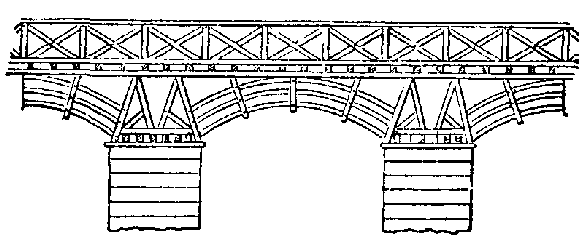 Fig. 1.?Trajan's Bridge.
Whatever type of bridge is adopted, the engineer has to ascertain the loads to be carried, and to proportion the parts so that the stresses due to the loads do not exceed limits found by experience to be safe. In many countries the limits of working stress in public and railway bridges are prescribed by law. The development of theory has advanced pari passu with the demand for bridges of greater strength and span and of more complex design, and there is now little uncertainty in calculating the stresses in any of the types of structure now adopted. In the modern metal bridge every member has a definite function and is subjected to a calculated straining action. Theory has been the guide in the development of bridge design, and its trustworthiness is completely recognized. The margin of uncertainty which must be met by empirical allowances on the side of safety has been steadily diminished.
The larger the bridge, the more important is economy of material, not only because the total expenditure is more serious, but because as the span increases the dead weight of the structure becomes a greater fraction of the whole load to be supported. In fact, as the span increases a point is reached at which the dead weight of the superstructure becomes so large that a limit is imposed to any further increase of span.
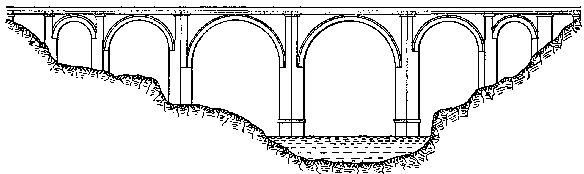 Fig. 2.?Bridge of Alcantara.
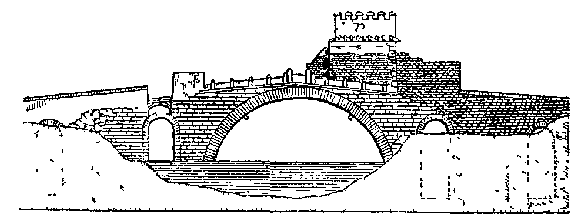 Fig. 3.?Ponte Salario.
4. Roman Bridges.?The first bridge known to have been constructed at Rome over the Tiber was the timber Pons Sublicius, the bridge defended by Horatius. The Pons Milvius, now Ponte Molle, was reconstructed in stone by M. Aemilius Scaurus in 109 B.C., and some portions of the old bridge are believed to exist in the present structure. The arches vary from 51 to 79 ft. span. The Pons Fabricius (mod. Ponte dei Quattro Capi), of about 62 B.C., is practically intact; and the Pons Cestius, built probably in 46 B.C., retains much of the original masonry. The Pons Aelius, built by Hadrian A.D. 134 and repaired by Pope Nicholas II. and Clement IX., is now the bridge of St Angelo. It had eight arches, the greatest span being 62 ft.[1] Dio Cassius mentions a bridge, possibly 3000 to 4000 ft. in length, built by Trajan over the Danube in A.D. 104. Some piers are said still to exist. A bas-relief on the Trajan column shows this bridge with masonry piers and timber arches, but the representation is probably conventional (fig. 1). Trajan also constructed the bridge of Alcantara in Spain (fig. 2), of a total length of 670 ft., at 210 ft. above the stream. This had six arches and was built of stone blocks without cement. The bridge of Narses, built in the 6th century (fig. 3), carried the Via Salaria over the Anio. It was destroyed in 1867, during the approach of Garibaldi to Rome. It had a fortification such as became usual in later bridges for defence or for the enforcement of tolls. The great lines of aqueducts built by Roman engineers, and dating from 300 B.C. onwards, where they are carried above ground, are arched bridge structures of remarkable magnitude (see Aqueducts, § Roman). They are generally of brick and concrete.
