by Various
Available in 585 free installments
Owner:
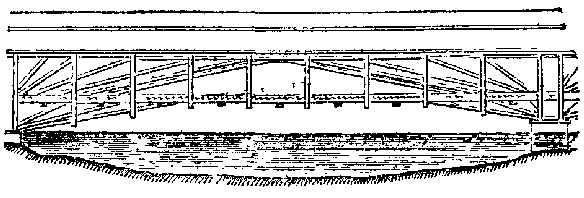 Fig. 4.?First Span of Schaffhausen Bridge.
5. Medieval and other Early Bridges.?Bridges with stone piers and timber superstructures were no doubt constructed from Roman times onward, but they have perished. Fig. 4 shows a timber bridge erected by the brothers Grubenmann at Schaffhausen about the middle of the 18th century. It had spans of 172 and 193 ft., and may be taken as a representative type of bridges of this kind. The Wittingen bridge by the same engineers had a span of 390 ft., probably the longest timber span ever constructed. Of stone bridges in Great Britain, the earliest were the cyclopean bridges still existing on Dartmoor, consisting of stone piers bridged by stone slabs. The bridge over the East Dart near Tavistock had three piers, with slabs 15 ft. by 6 ft. (Smiles, Lives of the Engineers, ii. 43). It is reputed to have lasted for 2000 years.
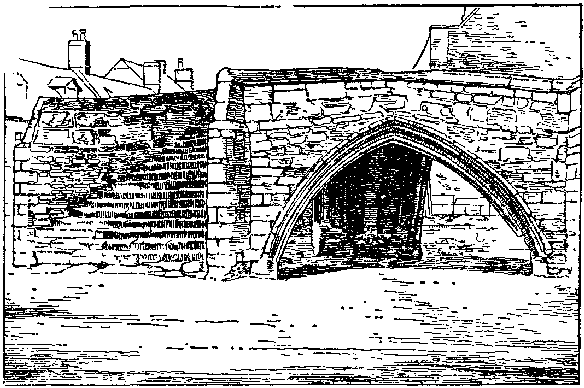 Fig. 5.?Crowland Bridge.
The curious bridge at Crowland near Peterborough (fig. 5) which now spans roadways, the streams which formerly flowed under it having been diverted, is one of the earliest known stone bridges in England. It is referred to in a charter of the year 943. It was probably built by the abbots. The first bridges over the Thames at London were no doubt of timber. William of Malmesbury mentions the existence of a bridge in 994. J. Stow (Survey of the Cities of London and Westminster) describes the building of the first stone bridge commonly called Old London Bridge: "About the year 1176, the stone bridge was begun to be founded by Peter of Colechurch, near unto the bridge of timber, but more towards the west." It carried timber houses (fig. 6) which were frequently burned down, yet the main structure existed till the beginning of the 19th century. The span of the arches ranged from 10 to 33 ft., and the total waterway was only 337 ft. The waterway of the present London Bridge is 690 ft., and the removal of the obstruction caused by the old bridge caused a lowering of the low-water level by 5 ft., and a considerable deepening of the river-bed. (See Smiles, Lives of the Engineers, "Rennie.")
 Fig. 6.?Old London Bridge, A.D. 1600. From a Drawing in the Pepysian Library Magdalene College, Cambridge.
From J. R Green's A Short History of the English People, by permission of Macmillan & Co., Ltd.
The architects of the Renaissance showed great boldness in their designs. A granite arch built in 1377 over the Adda at Trezzo had a span at low water of 251 ft. This noble bridge was destroyed for military reasons by Carmagnola in 1416. The Rialto bridge at Venice, with a span of 91 ft., was built in 1588 by Antonio da Ponte. Fig. 7 shows the beautiful Ponte dellà Trinità erected at Florence in 1566 from the design of B. Ammanati.
