by Various
Available in 585 free installments
Owner:
On the first English railways cast iron girder bridges for spans of 20 to 66 ft. were used, and in some cases these were trussed with wrought iron. When in 1845 the plans for carrying the Chester and Holyhead railway over the Menai Straits were considered, the conditions imposed by the admiralty in the interests of navigation involved the adoption of a new type of bridge. There was an idea of using suspension chains combined with a girder, and in fact the tower piers were built so as to accommodate chains. But the theory of such a combined structure could not be formulated at that time, and it was proved, partly by experiment, that a simple tubular girder of wrought iron was strong enough to carry the railway. The Britannia bridge (fig. 16) has two spans of 460 and two of 230 ft. at 104 ft. above high water. It consists of a pair of tubular girders with solid or plate sides stiffened by angle irons, one line of rails passing through each tube. Each girder is 1511 ft. long and weighs 4680 tons. In cross section (fig. 17), it is 15 ft. wide and varies in depth from 23 ft. at the ends to 30 ft. at the centre. Partly to counteract any tendency to buckling under compression and partly for convenience in assembling a great mass of plates, the top and bottom were made cellular, the cells being just large enough to permit passage for painting. The total area of the cellular top flange of the large-span girders is 648 sq. in., and of the bottom 585 sq. in. As no scaffolding could be used for the centre spans, the girders were built on shore, floated out and raised by hydraulic presses. The credit for the success of the Conway and Britannia bridges must be divided between the engineers. Robert Stephenson and William Fairbairn, and Eaton Hodgkinson, who assisted in the experimental tests and in formulating the imperfect theory then available. The Conway bridge was first completed, and the first train passed through the Britannia bridge in 1850. Though each girder has been made continuous over the four spans it has not quite the proportions over the piers which a continuous girder should have, and must be regarded as an imperfectly continuous girder. The spans were in fact designed as independent girders, the advantage of continuity being at that time imperfectly known. The vertical sides of the girders are stiffened so that they amount to 40% of the whole weight. This was partly necessary to meet the uncertain conditions in floating when the distribution of supporting forces was unknown and there were chances of distortion.
 Fig. 16.?Britannia Bridge.
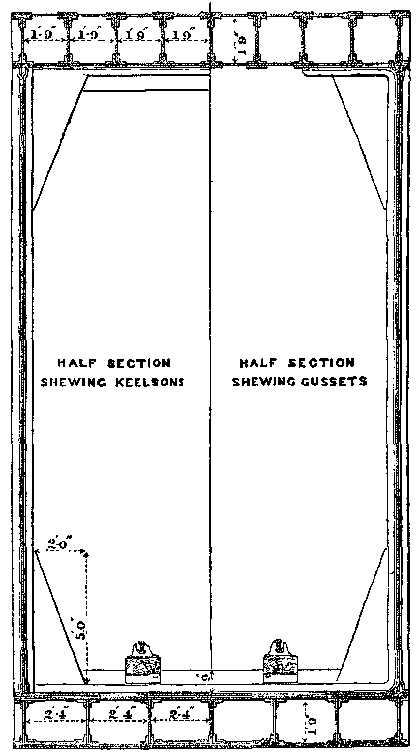 Fig. 17.?Britannia Bridge (Cross Section of Tubular Girder).
Wrought iron and, later, steel plate web girders were largely used for railway bridges in England after the construction of the Conway and Menai bridges, and it was in the discussions arising during their design that the proper function of the vertical web between the top and bottom flanges of a girder first came to be understood. The proportion of depth to span in the Britannia bridge was 1/16. But so far as the flanges are concerned the stress to be resisted varies inversely as the depth of the girder. It would be economical, therefore, to make the girder very deep. This, however, involves a much heavier web, and therefore for any type of girder there must be a ratio of depth to span which is most economical. In the case of the plate web there must be a considerable excess of material, partly to stiffen it against buckling and partly because an excess of thickness must be provided to reduce the effect of corrosion. It was soon found that with plate webs the ratio of depth to span could not be economically increased beyond 1/15 to 1/12. On the other hand a framed or braced web afforded opportunity for much better arrangement of material, and it very soon became apparent that open web or lattice or braced girders were more economical of material than solid web girders, except for small spans. In America such girders were used from the first and naturally followed the general design of the earlier timber bridges. Now plate web girders are only used for spans of less than 100 ft.
