by Various
Available in 585 free installments
Owner:
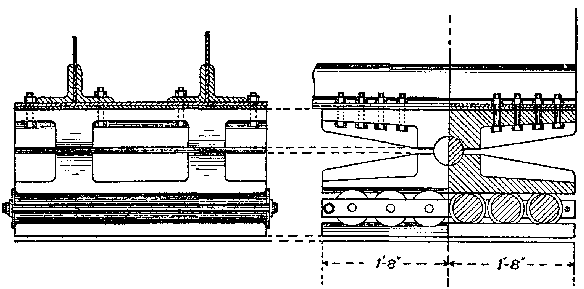 Fig. 14.?Roller Bed of a Girder.
In the girders of bridges the horizontal girder is almost exclusively subjected to vertical loading forces. Investigation of the internal stresses, which balance the external forces, shows that most of the material should be arranged in a top flange, boom or chord, subjected to compression, and a bottom flange or chord, subjected to tension. (See Strength of Materials.) Connecting the flanges is a vertical web which may be a solid plate or a system of bracing bars. In any case, though the exact form of cross section of girders varies very much, it is virtually an I section (fig. 15). The function of the flanges is to resist a horizontal tension and compression distributed practically uniformly on their cross sections. The web resists forces equivalent to a shear on vertical and horizontal planes. The inclined tensions and compressions in the bars of a braced web are equivalent to this shear. The horizontal stresses in the flanges are greatest at the centre of a span. The stresses in the web are greatest at the ends of the span. In the most numerous cases the flanges or chords are parallel. But girders may have curved chords and then the stresses in the web are diminished.
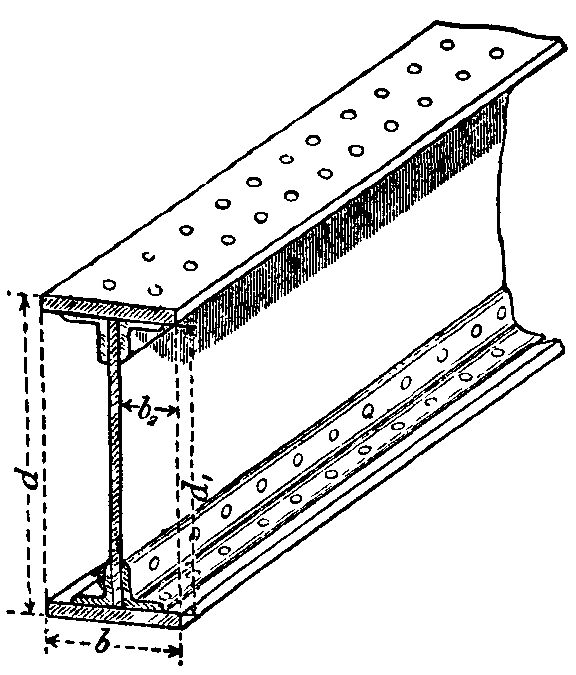 Fig. 15.?Flanged Girder.
At first girders had solid or plate webs, but for spans over 100 ft. the web always now consists of bracing bars. In some girder bridges the members are connected entirely by riveting, in others the principal members are connected by pin joints. The pin system of connexion used in the Chepstow, Saltash, Newark Dyke and other early English bridges is now rarely used in Europe. But it is so commonly used in America as to be regarded as a distinctive American feature. With pin connexions some weight is saved in the girders, and erection is a little easier. In early pin bridges insufficient bearing area was allowed between the pins and parts connected, and they worked loose. In some cases riveted covers had to be substituted for the pins. The proportions are now better understood. Nevertheless the tendency is to use riveted connexions in preference to pins, and in any case to use pins for tension members only.
