by Various
Available in 585 free installments
Owner:
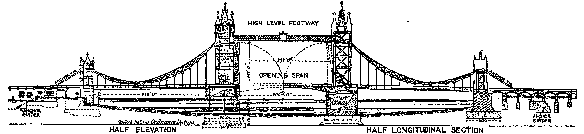 Fig. 13.?Tower Bridge, London.
The Tower Bridge, London (fig. 13), is a suspension bridge with a secondary bascule bridge in the centre span to permit the passage of ships. Two main towers in the river and two towers on the shore abutments carry the suspension chains. The opening bridge between the river towers consists of two leaves or bascules, pivoted near the faces of the piers and rotating in a vertical plane. When raised, the width of 200 ft. between the main river piers is unobstructed up to the high-level foot-bridge, which is 141 ft. above Trinity H.W. The clear width of the two shore spans is 270 ft. The total length of the bridge is 940 ft., and that of the approaches 1260 ft. on the north and 780 ft. on the south. The width of the bridge between parapets is 60 ft., except across the centre span, where it is 49 ft. The main towers consist of a skeleton of steel, enclosed in a facing of granite and Portland stone, backed with brickwork. There are two high-level footways for use when the bascules are raised, the main girders of which are of the cantilever and suspended girder type. The cantilevers are fixed to the shore side of the towers. The middle girders are 120 ft. in length and attached to the cantilevers by links. The main suspension chains are carried across the centre span in the form of horizontal ties resting on the high-level footway girders. These ties are jointed to the hanging chains by pins 20 in. in diameter with a ring in halves surrounding it 5 in. thick. One half ring is rigidly attached to the tie and one to the hanging chain, so that the wear due to any movement is distributed over the length of the pin. A rocker bearing under these pins transmits the load at the joint to the steel columns of the towers. The abutment towers are similar to the river towers. On the abutment towers the chains are connected by horizontal links, carried on rockers, to anchor ties. The suspension chains are constructed in the form of braced girders, so that they are stiff against unsymmetrical loading. Each chain over a shore span consists of two segments, the longer attached to the tie at the top of the river tower, the shorter to the link at the top of the abutment tower, and the two jointed together at the lowest point. Transverse girders are hung from the chains at distances of 18 ft. There are fifteen main transverse girders to each shore span, with nine longitudinal girders between each pair. The trough flooring, ? in. thick and 6 in. deep, is riveted to the longitudinals. The anchor ties are connected to girders embedded in large concrete blocks in the foundations of the approach viaducts.
The two bascules are each constructed with four main girders. Over the river these are lattice girders, with transverse girders 12 ft. apart, and longitudinal and subsidiary transverse girders dividing the floor into rectangles 3 ft. by 3½ ft. covered with buckled plates. The roadway is of pine blocks dowelled. The bascules rotate through an angle of 82°, and their rear ends in the bascule chambers of the piers carry 365 tons of counterweight, the total weight of each being 1070 tons. They rotate on steel shafts 21 in. in diameter and 48 ft. long, and the bascules can be lifted or lowered in one minute, but usually the time taken is one and a half minutes. They are worked by hydraulic machinery.
9. (d) Iron and Steel Girder Bridges.?The main supporting members are two or more horizontal beams, girders or trusses. The girders carry a floor or platform either on top (deck bridges) or near the bottom (through bridges). The platform is variously constructed. For railway bridges it commonly consists of cross girders, attached to or resting on the main girders, and longitudinal rail girders or stringers carried by the cross girders and directly supporting the sleepers and rails. For spans over 75 ft., expansion due to change of temperature is provided for by carrying one end of each chain girder on rollers placed between the bearing-plate on the girder and the bed-plate on the pier or abutment.
Fig. 14 shows the roller bed of a girder of the Kuilenburg bridge of 490 ft. span. It will be seen that the girder directly rests on a cylindrical pin or rocker so placed as to distribute the load uniformly to all the rollers. The pressure on the rollers is limited to about p = 600 d in lb per in. length of roller, where d is the diameter of the roller in inches.
