by The Open University
Available in 42 free installments
Owner:
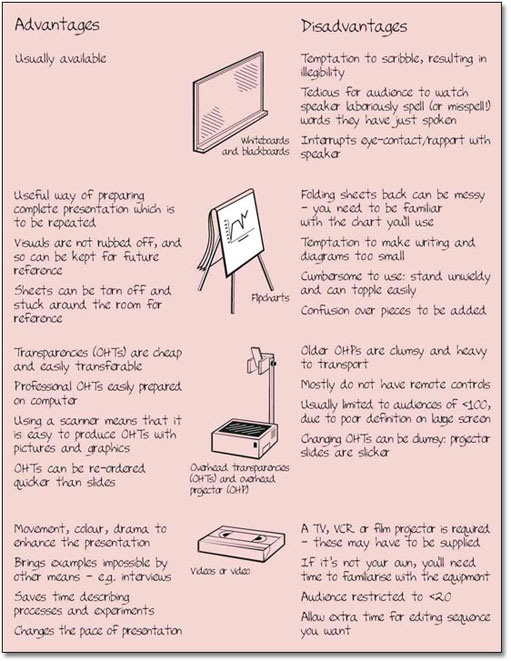
In this section we'll consider what visual aids are available and which are the most practical for you and your presentation. The function of visual aids is to illustrate your talk; you need to be selective so as to not overwhelm your audience.
Points to bear in mind include:
Use prepared visuals for:
complex inter-related ideas
persuasive communication.
Words alone are not visual aids ? where you do use them make them provide visual impact by means of graphic devices:
underlining and boxes and circles
bullets and dashes (as in this example)
careful layout
use of space.
Don't use overcomplicated visual aids ? everybody in the audience must understand every aid you use by the time you have finished with it.
Visuals must complement what you say.
You should have a visual for everything you want your audience to remember.
Don't have a visual aid which you don't need.
Make sure there are no spelling mistakes.
You don't have to be a professional to produce good materials.
Write down briefly what you think visual aids can be used for in a presentation.
You can use visual aids to:
convey an idea, concept, theory or hypothesis
illustrate your text with graphs, graphics or simply line drawings
clarify a point, or restate a point for added significance
summarise the structure or content of a section or topic
summarise key concepts or key areas
give instructions for an activity
present material to trigger a discussion
work as an aid to personal reflection, e.g. inventories, checklists
add interest and variety
build up visuals to develop an idea
help the audience recall a concept or idea, either from their own past or from your talk content.
It is a fortunate coincidence that many of them can act as aides-memoir to you as the presenter, which helps keep the story or argument on track. This could be especially useful if you have to speak to slides in blackout conditions, when technology is not always necessary to succeed.