by Wikibooks, open books for an open world
Available in 126 free installments
Owner:
A particle is said to move with constant acceleration if its velocity changes by equal amounts in equal intervals of time, no matter how small the intervals may be.
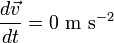 |
Since acceleration is a vector, constant acceleration means that both direction and magnitude of this vector don't change during the motion. This means that average and instantaneous acceleration are equal. We can use that to derive an equation for velocity as a function of time by integrating the constant acceleration.
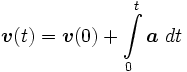 |
Giving the following equation for velocity as a function of time.
 |
To derive the equation for position we simply integrate the equation for velocity.
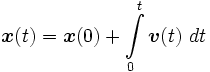 |
Integrating again gives the equation for position.
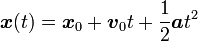 |
The following are the 'Equations of Motion'. They are simple and obvious equations if you think over them for a while.
| Equation | Description |
|---|---|
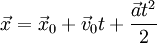 |
Position as a function of time |
 |
Velocity as a function of time |
| The following equations can be derived from the two equations above by combining them and eliminating variables. | |
 |
Eliminating time (Very useful, see the section on Energy) |
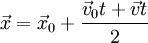 |
Eliminating acceleration |
| Symbol | Description |
|---|---|
 |
velocity at time t |
 |
initial velocity |
 |
acceleration (constant) |
 |
time taken during the motion |
 |
position at time t |
 |
initial position |
