by Wikibooks, open books for an open world
Available in 126 free installments
Owner:
 |
 |
Let us prove this law.
We'll take two particles, say, a and b. Their momentums are  and
and  .They are moving opposite to each other along the x-axis and they collide. Now force is given by:

According to Newton's third law,the forces on each particle are equal and opposite.So,
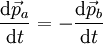
Rearranging,
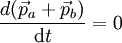
This means that the sum of the momentums does not change with time. Therefore, the law is proved.
