by Wikibooks, open books for an open world
Available in 126 free installments
Owner:
Work is equal to the scalar product of force and displacement.
 |
The scalar product of two vectors is defined as the product of their lengths with the cosine of the angle between them. Work is equal to force times displacement times the cosine of the angle between the directions of force and displacement.
 |
Work is equal to change in kinetic energy plus change in potential energy for example the potenitial energy due to gravity.
 |
Work is equal to average power times time.
 |
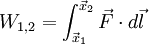
The Work done by a force taking something from point 1 to point 2 is
 |
Work is in fact just a transfer of energy. When we 'do work' on an object, we transfer some of our energy to it. This means that the work done on an object is its increase in energy. Actually, the kinetic energy and potential energy is measured by calculating the amount of work done on an object. The gravitational potential energy (there are many types of potential energies) is measure as 'mgh'. mg is the weight/force. And h is the distance. The product is nothing but the work done. Even kinetic energy is a simple deduction from the laws of linear motion. Try substituing for v^2 in the formula for kinetic energy.
