by Wikibooks, open books for an open world
Available in 126 free installments
Owner:
 A two dimensional polar co-ordinate system
Uniform circular motion assumes that an object is moving (1) in circular motion, and (2) at constant speed v; then

where r is the radius of the circular path, and T is the time period for one revolution.
Any object travelling on a circle will return to its original starting point in the period of one revolution, T. At this point the object has travelled a distance 2?r. If T is the time that it takes to travel distance 2?r then the object's speed is
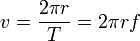
where 
Uniform circular motion can be explicitly described in terms of polar coordinates through angular frequency, ?:

where ? is the angular coordinate of the object (see the diagram on the right-hand side for reference).
Since the speed in uniform circular motion is constant, it follows that

From that fact, a number of useful relations follow:
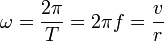
The equations that relate how ? changes with time are analogous to those of linear motion at constant speed. In particular,

The angle at t = 0, ?0, is commonly referred to as phase.
The position of an object in a plane can be converted from polar to cartesian coordinates through the equations


Expressing ? as a function of time gives equations for the cartesian coordinates as a function of time in uniform circular motion:


Differentiation with respect to time gives the components of the velocity vector:


Velocity in circular motion is a vector tangential to the trajectory of the object. Furthermore, even though the speed is constant the velocity vector changes direction over time. Further differentiation leads to the components of the acceleration (which are just the rate of change of the velocity components):


The acceleration vector is perpendicular to the velocity and oriented towards the centre of the circular trajectory. For that reason, acceleration in circular motion is referred to as centripetal acceleration.
The absolute value of centripetal acceleration may be readily obtained by

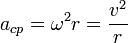
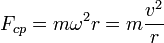
For centripetal acceleration, and therefore circular motion, to be maintained a centripetal force must act on the object. From Newton's Second Law it follows directly that the force will be given by

the components being


and the absolute value