by Wikibooks, open books for an open world
Available in 126 free installments
Owner:
|
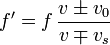
f' is the observed frequency, f is the actual frequency, v is the speed of sound (v = 336 + 0.6T), T is temperature in degrees Celsius v0 is the speed of the observer, and vs is the speed of the source. If the observer is approaching the source, use the top operator (the +) in the numerator, and if the source is approaching the observer, use the top operator (the -) in the denominator. If the observer is moving away from the source, use the bottom operator (the -) in the numerator, and if the source is moving away from the observer, use the bottom operator (the +) in the denominator.
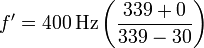
A. An ambulance, which is emitting a 400 Hz siren, is moving at a speed of 30 m/s towards a stationary observer. The speed of sound in this case is 339 m/s.
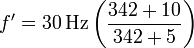
B. An M551 Sheridan, moving at 10 m/s is following a Renault FT-17 which is moving in the same direction at 5 m/s and emitting a 30 Hz tone. The speed of sound in this case is 342 m/s.