(xxv) Parc-y-Meirch (North Wales). Here Mr. Willoughby Gardner has further continued his valuable excavations (Report for 1913, p. 25). The new coin-finds seem to hint that the later fourth-century stratum may have been occupied earlier in that century than the date which I gave last year, A.D. 340. But the siege of this hill-fort is bound to be long and its full results will not be clear till the end. Then we may expect it to throw real light on an obscure corner of the history of Roman and also post-Roman Wales.
This section includes the Roman inscriptions which have been found, or (perhaps I should say) first recognized to exist, in Britain in 1914 or which have become more accurately known in that year. As in 1913, the list is short and its items are not of great importance; but the Chesterholm altar (No. 5) deserves note, and the Corbridge tile also possesses considerable interest.
I have edited them in the usual manner, first stating the origin, character, &c., of the inscription, then giving its text with a rendering in English, thirdly adding any needful notes and acknowledging obligations to those who may have communicated the items to me. In the expansions of the text, square brackets denote letters which, owing to breakage or other cause, are not now on the stone, though one may presume that they were originally there; round brackets denote expansions of Roman abbreviations. The inscriptions are printed in the same order as the finds in section A, that is, from north to south?though with so few items the order hardly matters.
(1) Found at Balmuildy (above, p. 7) in the annexe to the south-east of the fort proper, some sandstone fragments from the top of a small altar, originally perhaps about 14 inches wide. At the top, in a semicircular panel is a rude head; below are letters from the first two lines of the dedication; probably the first line had originally four letters:?
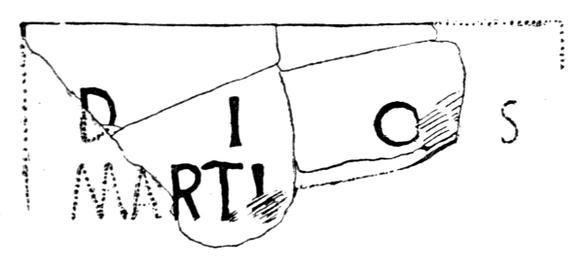
Possibly DIO may be for deo. It is by no means a common orthography, but if it be accepted, we can read dio [s(ancto) Ma]rti.... The reading DIIO, deo, is I fear impossible.
I have to thank Mr. S. N. Miller, the excavator, for photographs.
(2) At Traprain Law (above, p. 8) a small potsherd from a second-century level bore the letters scratched on it

These letters were on the side of the potsherd which had formed the inner surface when the pot was whole; they must therefore have been inscribed after the pot had been smashed, and the size and shape of the bit give cause to think that it may have been broken intentionally for inscription?possibly for use in some game. In any case, it must have been inscribed at Traprain Law, and not brought there already written, and the occurrence of writing of any sort on such a site is noteworthy.
I am indebted to Dr. G. Macdonald for a sight of the piece.
(3) Found about three and a half miles north of the Roman fort Bremenium, High Rochester, near Horsley in north Northumberland, beside the Roman road over the Cheviots (Dere Street), close to the steading of Featherwood, in the autumn of 1914, now in the porch of Horsley Parish Church, a plain altar 51 inches high by 22 inches wide, with six lines of letters 2 inches tall. The inscription is unusually illegible. Only the first and last lines are readable with certainty; elsewhere some letters can be read or guessed, but not so as to yield coherent sense.
