 |
(only bottom of final E visible) |
 |
(ET probable, IVL fairly certain) |
 |
(only M quite certain) |
 |
(erased on purpose) |
 |
|
 |
The altar was dedicated to Victory; nothing else is certain. It is tempting to conjecture in line 2 ET N AVG, et numinibus Augustorum, as on some other altars to Victory, but ET is not certain, though probable, and N AVG is definitely improbable. The fourth line seems to have been intentionally erased. I find no sign of any mention of the Cohors I Vardullorum, which garrisoned Bremenium, though it or its commander might naturally be concerned in putting up such an altar.
We may assume that the altar belongs to Bremenium; possibly it was brought thence when Featherwood was built.
I have to thank the Rev. Thos. Stephens, vicar of Horsley, for photographs and an excellent squeeze and readings, and Mr. R. Blair for a photograph.
(4-5) Found on July 17, 1914, at Chesterholm, just south of Hadrian's Wall, lying immediately underneath the surface in a grass field 120 yards west of the fort, two altars:
(4) 32 inches tall, 15 inches broad, illegible save for the first line

I(ovi) o(ptimo) m(aximo)....
(5) 34 inches tall, 22 inches broad, with 8 lines of rather irregular letters, not quite legible at the end (fig. 16).
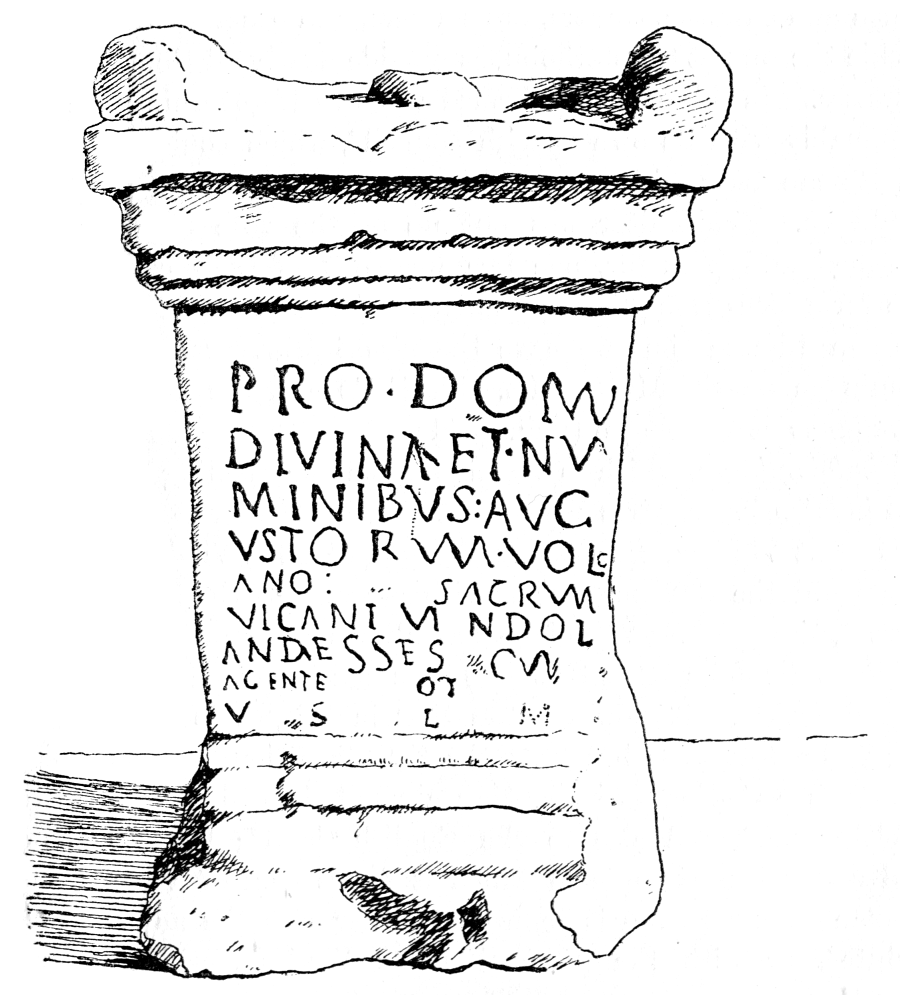
Pro domu divina et numinibus Augustorum, Volcano sacrum, vicani Vindolandesses, cu[r(am)] agente ... v(otum) s(olvit) l(ibens) m(erito).
'For the Divine (i.e. Imperial) House and the Divinity of the Emperors, dedicated to Vulcan by the members of the vicus of Vindolanda, under the care of ... (name illegible).'
The statement of the reason for the dedication given in the first three lines is strictly tautologous, the Divine House and the Divinity of the Emperors being practically the same thing. The formula numinibus Aug. is very common in Britain, though somewhat rare elsewhere; in other provinces its place is supplied by the formula in honorem domus divinae; it belongs mostly to the late second and third centuries. The plural Augustorum does not appear to refer to a plurality of reigning Emperors, but to the whole body of Emperors dead and living who were worshipped in the Cult of the Emperors.
The vicani Vindolandesses are the members of the settlement?women and children, traders, old soldiers, and others?which grew up outside the fort at Chesterholm, as outside nearly all Roman forts and fortresses. In this case they formed a small self-governing community, presumably with its own 'parish council', which could be called by the Roman term vicus, even if it was not all that a proper vicus should be. This altar was put up at the vote of their 'parish meeting' and paid for, one imagines, out of their common funds. The term vicus is applied to similar settlements outside forts on the German Limes; thus we have the vicani Murrenses at the fort of Benningen on the Murr (CIL. xiii. 6454) and the vicus Aurelius or Aurelianus at Oehringen (ibid. 6541).
