Vindolandesses, which is merely a phonetic spelling or misspelling of Vindolandenses, gives the correct name of the fort. In the Notitia it is spelt Vindolana, in the Ravennas (431. 11) Vindolanda; and as in general the Ravennas teems with errors and the Notitia is fairly correct, the spelling Vindolana has always been preferred, although (as Prof. Sir John Rhys tells me) its second part -lana is an etymological puzzle. It now appears that in this, as in some few other cases, the Ravennas has kept the true tradition. The termination -landa is a Celtic word denoting a small defined space, akin to the Welsh 'llan', and also to the English 'land'; I cannot, however, find any other example in which it forms part of a place-name of Roman date. Vindo- is connected either with the adjective vindos, 'white', or with the personal name Vindos derived from that adjective.
I have to thank Mrs. Clayton, the owner of Chesterholm, and her foreman, Mr. T. Hepple, for excellent photographs and squeezes. The altars are now in the Chesters Museum.
(6) Found at Corbridge, in August 1914, fragment of a tile, 7 × 8 inches in size, on which, before it was baked hard, some one had scratched three lines of lettering about 1-1-1/2 inches tall; the surviving letters form the beginnings of the lines of which the ends are broken off. There were never more than three lines, apparently.
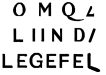
The inscription seems to have been a reading lesson. First the teacher scratched two lines of letters, in no particular order and making no particular sense; then he added the exhortation lege feliciter, 'read and good luck to you'. A modern teacher, even though he taught by the aid of a slate in lieu of a soft tile, might have expressed himself less gracefully. The tile may be compared with the well-known tile from Silchester, on which Maunde Thompson detected a writing lesson (Eph. Epigr. ix. 1293). A knowledge of reading and writing does not seem to have been at all uncommon in Roman Britain or in the Roman world generally, even among the working classes; I may refer to my Romanization of Roman Britain (ed. 3, pp. 29-34).
The imperfectly preserved letter after Q in line 1 was perhaps an angular L or E; that after D, in line 2, may have been M or N or even A.
I am indebted to Mr. R. H. Forster for a photograph and squeeze of the tile.
(7) Found in a peat-bog in Upper Weardale, in August 1913, two bronze skillets or 'paterae', of the usual saucepan shape, the larger weighing 15-1/2 oz., the smaller 8-1/2 oz. Each bore a stamp on the handle; the smaller had also a graffito on the rim of the bottom made by a succession of little dots. An uninscribed bronze ladle was found with the 'paterae':
| (a) on the larger patera: |  |
| (b) on the smaller: | 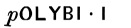 |
| (c) punctate: |  |
The stamps of the Campanian bronze-worker Cipius Polybius are well known. Upwards of forty have been found, rather curiously distributed (in the main) between Pompeii and places on or near the Rhenish and Danubian frontiers, in northern Britain, and in German and Danish lands outside the Roman Empire. The stamped 'paterae' of other Cipii and other bronze-workers have a somewhat similar distribution; it seems that the objects were made in the first century A.D., in or near Pompeii, and were chiefly exported to or beyond the borders of the Empire. Their exact use is still uncertain, I have discussed them in the Archaeological Journal, xlix, 1892, pp. 228-31; they have since been treated more fully by H. Willers (Bronzeeimer von Hemmoor, 1901, p. 213, and Neue Untersuchungen über die römische Bronzeindustrie, 1907, p. 69).
