Dorset
(8) In the Numismatic Chronicle for 1914 (pp. 92-5), Mr. H. Symonds lists 107 'third brass' from a hoard found (it seems) about 1850 near Puncknoll. They consist of 3 Gallienus, 2 Salonina, 55 Postumus, 40 Victorinus, 3 Tetricus, 1 Tetricus junior, 2 Claudius Gothicus, and 1 Garausius. The hoard was, then, of a familiar type; its original size we cannot guess. A brief reference to the same hoard occurs in the Proceedings of the Dorset Natural History and Antiquarian Field Club (xxxv, p. li).
(9) The latter periodical (pp. 88, 118) also contains Mr. H. Gray's Fifth Report on the gradual exploration of the Roman amphitheatre and the underlying prehistoric remains at Maumbury Rings, Dorchester?now substantially concluded?and an interesting little note on the New Forest pottery-works by Mr. Sumner (p. xxxii).
Essex
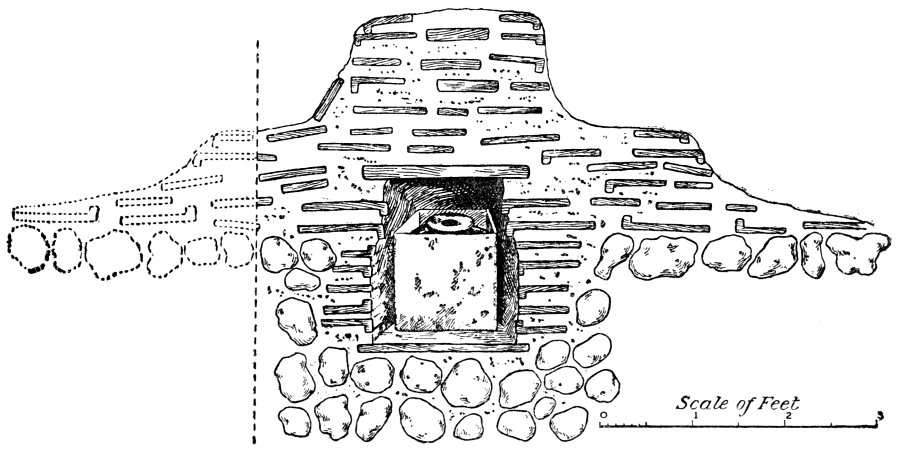
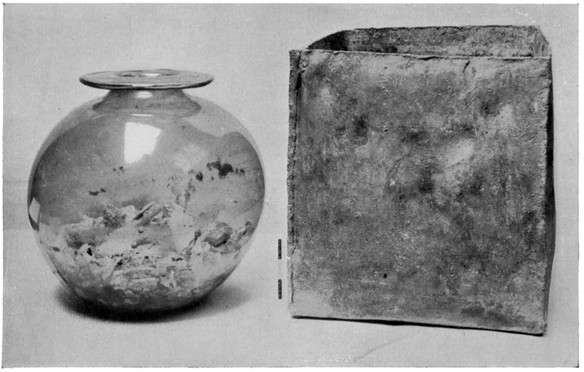
(10) By the kindness of the Morant Club and the Essex Archaeological Society, I am able to reproduce here three illustrations of the finds in the Mersea Mound, which I mentioned in my Report for 1913 (p. 42). Figs. 20, 22 show a view of the actual tomb; fig. 21 shows the chief contents. The interest of these half-native, half-Roman grave-mounds, which occur in eastern Britain and in the Low Countries opposite, will justify their insertion here. I may also correct an error in my account. No 'Samian stamped VITALIS' was found at Mersea, but objects which have been elsewhere found in association with that stamp.
(11) Two small Essex excavations are recorded in the Transactions of the Essex Archaeological Society, vol. xiii. At Chadwell St. Mary, near Tilbury, Mr. Miller Christy and Mr. F. W. Reader explored an early-looking mound, only to find that it was probably mediaeval (pp. 218-33). At Hockley, also in South Essex, the same archaeologists with Mr. E. B. Francis dug into a similar mound and met with many potsherds of Roman date and a coin of Domitian; no trace of a burial was detected, such as has come to light in other Romano-British mounds at Mersea, Bartlow, and elsewhere (ibid., p. 224). Indeed, it does not seem quite clear that the mound was thrown up in Roman times; it may have been reared later, with earth which contained Romano-British objects.
Gloucester
(12) The Transactions of the Bristol and Gloucestershire Archaeological Society (vol. xxxvi) refers to excavations at Sea Mills, on the King's Weston estate, in February 1913; the finds appear not to have been extensive. They also record the transfer of the Roman 'villa' at Witcombe to the care of H.M. Office of Works by the owner, Mr. W. F. Hicks-Beach.
Hants
(13) Mr. Heywood Sumner's pamphlet Excavations on Rockbourne Down (London, 1914, p. 43) is a readable, scholarly, and well-illustrated account of a Romano-British farm-site five miles south-west of Salisbury on the edge of Cranborne Chase. Mr. Sumner excavated parts of it in 1911-13; his account appeared so early in 1914 that it found a place in my Report for 1913 (pp. 23-5).
(14) Some Roman roads in Hampshire are treated in the Papers and Proceedings of the Hampshire Field Club and Archaeological Society (vii, part 1). Capt. G. A. Kempthorne writes on the road east and west of Silchester and Mr. Karslake adds a word as to the line outside the west gate of that town, which he puts north of the generally assumed line (p. 25). Mr. O. G. S. Crawford and Mr. J. P. Freeman-Williams deal with very much more uncertain roads in the New Forest?one across Beaulieu Heath, another from Otterbourn to Ringwood (pp. 34-42).
