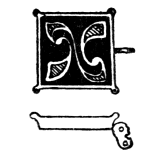
(32) About ten miles east from Nottingham, and a mile south of the village of East Bridgeford, the Fosse-way crosses a Roman site which has usually been identified with the Margidunum of the Antonine Itinerary. Lately excavation has been attempted, and the Antiquary of December 1914 contains an interesting account of the results attained up to the end of 1913, with some illustrations.12 A very broad earthwork and ditch surround an area of 7 acres, rhomboidal in shape (fig. 23). In this area the excavators, Drs. Felix Oswald and T. D. Pryce, have turned up floor-tesserae, roof-slates, flue-tiles, window-glass, painted wall-plaster, potsherds of the first and later centuries, including a black bowl with a well-modelled figure of Mercury in relief, coins ranging down to the end of the fourth century (Eugenius), and other small objects of interest, such as the small seal-box with Late-Celtic enamel, shown in fig. 24. No foundations in situ have yet come to light, but that is doubtless to follow; only a tiny part of the whole area has, as yet, been touched. Margidunum may have begun as a fort coeval with the Fosse-way, which (if I am right) dates from the earliest years of the Roman Conquest. Whether any of the first-century potsherds as yet found there can be assigned to these years (say A.D. 45-75) is not clear. But the excavations plainly deserve to be continued.
Shropshire
(33) Mr. Bushe-Fox's second Report on his excavations at Wroxeter (Reports of the Research Committee of the London Society of Antiquaries, No. II, Oxford, 1914) deserves all the praise accorded to his first Report. I can only repeat what I said of that; it is an excellent description, full and careful, minute in its account of the smaller finds, lavishly illustrated, admirably printed, and sold for half a crown. The finds which it enumerates in detail I summarized in my Report for 1913, pp. 19-20?the temple with its interesting Italian plan, the fragments of sculpture which seem to belong to it, the crowd of small objects, the masses of Samian (indefatigably recorded), the 528 coins; all combine to make up an admirable pamphlet.
I will venture a suggestion on the temple. This, as I pointed out last year, is on the Italian, not on the Celto-Roman plan. But one item is not quite clear in it. All ordinary classical temples stood on podia or platforms which raised them above the surrounding surface at least to some small extent. Mr. Bushe-Fox speaks of a podium to the Wroxeter temple. But it appears that he does not mean a podium, as generally understood. The masonry which he denotes by that term was, in his opinion, buried underground and merely foundation.
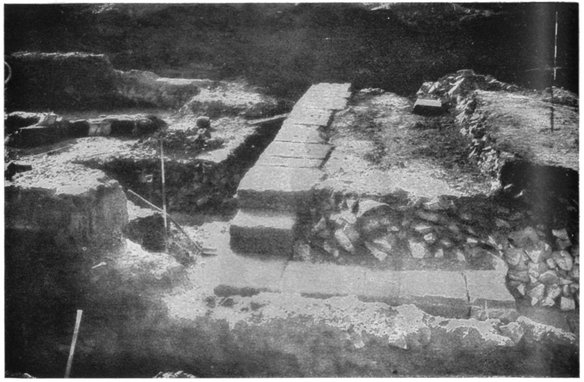
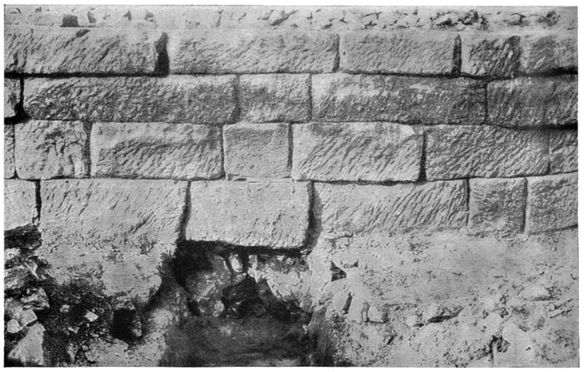
THE WROXETER TEMPLE. (p. 53)
