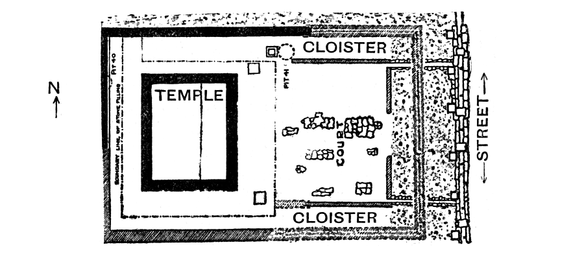
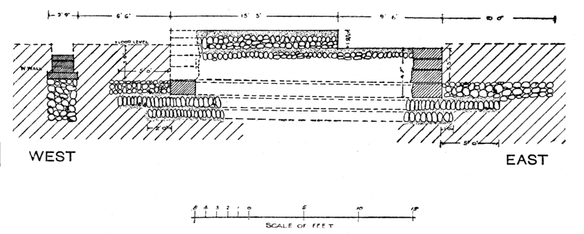
The floor of the portico of the temple (he says) was about level with the floor of the court which surrounded the temple; the floor of the cella, though higher, was but a trifle higher (see figs. 26, 27). This view needs more reflection than he has given it in his rather brief account. No doubt a temple in a Celtic land might have been built on a classical plan, though without a classical podium. But it is not what one would most expect. Nor do I feel sure that it was actually done at Wroxeter in this case. The walls which Mr. Bushe-Fox explains as the foundations of the temple are quite needlessly good masonry for foundations never meant to be seen; this will be plain from figs. 27, 28, which I reproduce by permission from his Report. Further, as fig. 26 (from the same source) shows, there was outside the base of this masonry a level cobbled surface, for which no structural reason is to be found. This, one may guess, was a pavement at the original ground-level when the temple was first erected; from this, steps presumably led up to the floor of the portico and cella. The 'podium', then, was at first a real podium. Later, the ground-level rose, and the walls of the podium were buried.
Somerset
(34) In his handsome volume, Wookey Hole, its caves and cave-dwellers (London, 1914), Mr. H. E. Balch collects for general antiquarian readers the results of his long exploration of this Mendip cave; some of these results were noted in my Report for 1913, p. 47. The cave, as a whole, contained?besides copious prehistoric remains?two well-defined Roman layers, with many potsherds, including a little Samian and one Samian stamp given as PIIR PIIT OFII (apparently a new variety of Perpetuus), broken glass, a few fibulae and other bronze and iron objects, and 106 coins. These coins are:?1 Republican (124-103 B.C., Marcia), 1 Vespasian, 1 Titus, 1 Trajan, 2 Hadrian, 2 Pius; then, 3 Gallienus, 1 Salonina, 1 Carausius, 2 Chlorus, 1 Theodora, 6 Constantinopolis, 1 Crispus, 4 Constantine II, 4 Magnentius, 4 Constantius II, with 20 Valentinian I, 14 Valens, 21 Gratian, 7 Valentinian II, and 6 illegible. Just two-thirds of the coins are later than A.D. 364; they may be set beside the late hoard found at Wookey Hole in 1852, which Mr. Balch might well have mentioned. Plainly, the later Roman layer in the cave belongs to the end of the fourth century. The date of the other layer is harder to fix, since we are not told how the coins and potsherds were distributed between the layers. Probably the cave was long inhabited casually but in the troubled time of the latest Empire became a place of refuge or otherwise attracted more numerous occupants. That, if true, is a more interesting result that Mr. Balch realizes. For in general the cave-life of Roman Britain belonged to the first two or three centuries of our era; it is only rarely, and mostly in the west country, that the caves contain among their Roman relics objects of the late fourth century (see Victoria Hist. Derbyshire, i. 233-42). I must add that Mr. Balch repeats on pp. 57-8 the error about the significance of the Republican coin which was noted in my Report for 1915.
(35) The Proceedings of the Somersetshire Archaeological and Natural History Society for 1913 (vol. lix, Taunton, 1914) record small Roman finds at Bratton and Barrington (part i, pp. 24, 65, 76, and part ii, p. 79), and describe in detail Mr. Gray's trial excavations at Cadbury Castle. Cadbury, it seems, was occupied mainly in the Celtic period, before the Roman conquest.
