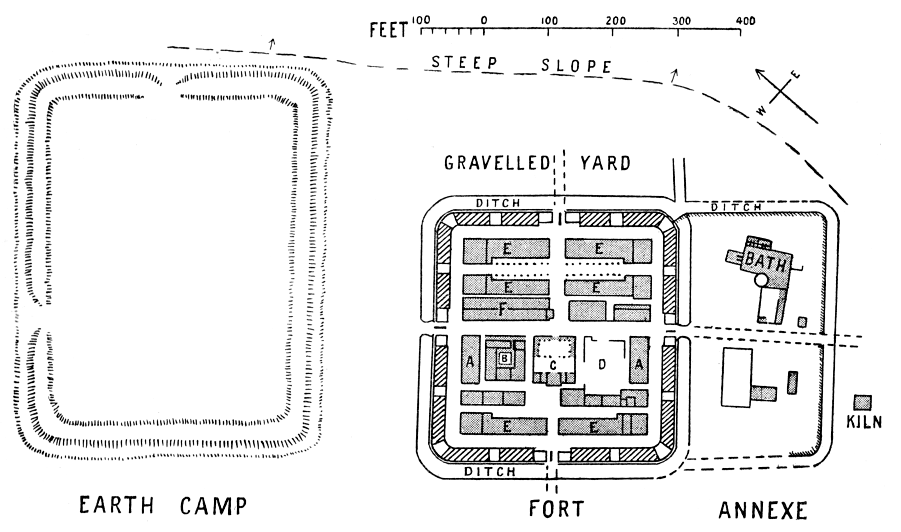
south of Chester, which I have described above (p. 15); the Commissioners' plan of the site seems to have an incorrect scale. Chance finds, important if not yet fully understood, have been found in British camps at Pen-y-corddin, Moel Fenlli, Moel y Gaer, and especially at Parc-y-Meirch or Dinorben (above, p. 28). Isolated coins have been found scantily?a hoard of perhaps 6,000 Constantinian copper at Moel Fenlli, a gold coin of Nero from the same hill, another coin of Nero at Llanarmon, 200-300 Constantinian at Llanelidan. A parcel of bronze 'cooking vessels' was found near Abergele (Eph. Epigr. iii. 130) but has unfortunately disappeared. The index also mentions coins under 'No. 458', which does not appear in the volume itself. A Roman road probably ran across the county from St. Asaph to Caerhyn (Canovium); its east end is pretty certain, as far as Glascoed, though the 'Inventory' hardly makes this clear.
(50) A partial plan and some views of the west gate of the Roman fort at the Gaer, near Brecon, are given in the Transactions of the Woolhope Naturalists' Field Club for 1908-11.
Scotland
(51) The fifth Report of the Royal Commission on Ancient and Historical Monuments in Scotland, Inventory of Monuments in Galloway. II. Stewartry of Kirkcudbright (Edinburgh, 1914) shows that the eastern half of Galloway, like the western half described in the fourth Report in 1912, contains nothing that can be called a 'Roman site' and very few Roman remains of any sort. Indeed this eastern half, the land between Dumfries and Newton Stewart, seems even poorer in such remains than the district between Newton Stewart and the Irish Sea. Its only items are some trifles of Samian, &c., found in the Borness Cave, and some iron implements found in a bronze caldron in Carlingwark Loch. This result is, of course, contrary to the views of older Scottish writers like Skene, who talked of 'numerous Roman camps and stations' in Galloway, but it will surprise no recent student. Probably the Romans never got far west of a line roughly coinciding with that of the Caledonian Railway from Carlisle by Carstairs to Glasgow. Their failure or omission to hold the south-west weakened the left flank and rear of their position on the Wall of Pius and helped materially to shorten their dominion in Scotland in the second century.
(52) In the Proceedings of the Society of Antiquaries of Scotland for 1913-4 (vol. xlviii) Mr. J. M. Corrie describes some polishers and other small objects found casually at Newstead (p. 338), and Dr. Macdonald expands (p. 395) the account of the Balcreggan hoard which he had contributed to the Scotsman (my Report for 1913, p. 11). Mr. A. O. Curle (p. 161) records the discovery and exploration of a vitrified fort at the Mote of Mark near Dalbeattie (Kirkcudbright), and the discovery in it of two clearly Roman potsherds. The main body of the finds made here seem to belong to the ninth century; whether any of them can be earlier than has been thought, I am not competent to decide.
(53) The well-known and remarkable earthworks at Birrenswark, near Lockerbie in Dumfriesshire, have long been explained as a Roman circumvallation13 or at least as siege-works round a native hill-fort. In 1913 they were visited by Prof. Schulten, of Erlangen, the excavator of a Roman circumvallation round the Spanish fortress of Numantia; they naturally interested him, and he has now described them for German readers (Neue Jahrbücher für das klassische Altertum, xxxiii, 1914, pp. 607-17) and added some remarks on their date. His description is clear and readable; his chronological arguments are less satisfactory. He adopts14 the view generally adopted by English archaeologists (except Roy) for the last two centuries, that these camps date from Agricola; he supports this old conclusion by reasons which are in part novel. I may summarize
