Dr. Schulten has not advanced matters by this speculation. His first point, that the four camps are coeval, and his reasons for that idea, are mainly taken from Roy?he does not make this clear in his paper. But he has not heeded Roy's warnings that the reasons are not cogent. Actually, they are very weak. At Channelkirk, only two sides of a camp remained in Roy's time; they measured not 1,250 × 1,800 feet but 1,330 × 1,660 feet, and the longer side had one gate in the middle, not two; to-day, next to nothing is visible. At Tassie's Holm there was only a corner of a perhaps quite small earthwork?not necessarily Roman?and the distance to Torwood Moor is nearer twenty than fourteen Roman miles. At Torwood Moor only one side, 1,780 feet long with two gates, was clear in Roy's time; the width of the camp is unknown. Cleghorn seems to have been fairly complete, but modern measurers give its size as 1,000 × 1,700 feet. Dr. Schulten builds on imaginary foundations when he calls these four camps coeval. He has not even proof that there were four camps.
Nor is his reason any more convincing for assigning these camps, and Birrenswark with them, to Agricola. Here he parts company from Roy and adduces an argument of his own?that Agricola was the only general who used both eastern and western routes. That is a mere assertion, unproven and improbable. Roman generals were operating in Scotland in the reigns of Pius and Marcus (A.D. 140-80) and Septimius Severus; if there were two routes, it is merely arbitrary to limit these men to the eastern route. As a matter of fact, the history of the western route is rather obscure; doubts have been thrown on its very existence north of Birrens. But if it did exist, the sites most obviously connected with it are the second-century sites of Birrens, Lyne, and Carstairs; at Birrenswark itself the only definitely datable finds, four coins, include two issues of Trajan.15
The truth is that the question is more complex than Dr. Schulten has realized. Possibly it is not ripe for solution. I have myself ventured, in previous publications, to date Birrenswark to Agricola?for reasons quite different from those of Dr. Schulten. But I would emphasize that we need, both there and at many earth-camps, full archaeological use of the spade. The circumstances of the hour are unfavourable to that altogether.
Herefordshire
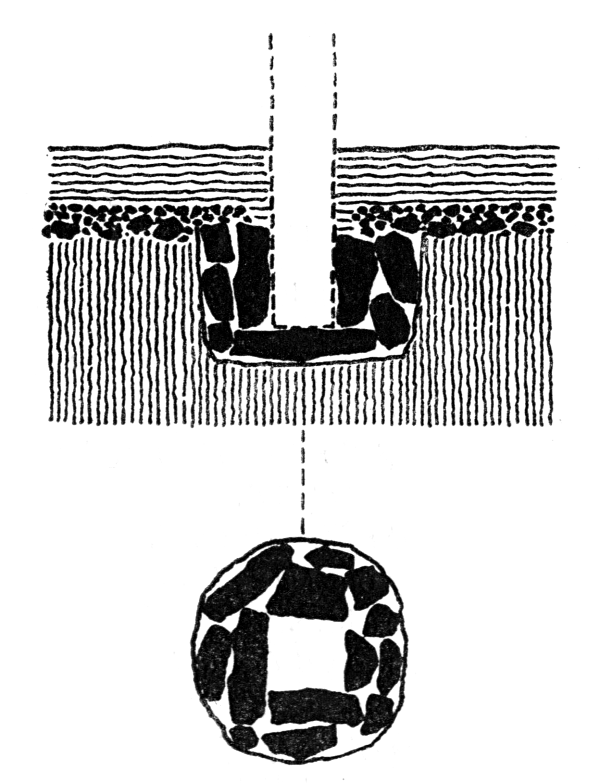
(54) As I go to press, I receive the Transactions of the Woolhope Naturalists' Field Club for 1908-11 (Hereford, 1914), a volume which, despite the date on its title-page, does not appear to have been actually issued till April 1915. It contains on pp. 68-73 and 105-9 two illustrated papers on three Roman roads of Herefordshire?Stone Street, the puzzling road near Leominster, and Blackwardine, the itinerary route between Gloucester and Monmouth. The find made at Donnington in 1906, which is explained on p. 69 as a 'villa' and on p. 109 as an agrimensorial pit?this latter an impossibility?was, I think, really a kiln, though there may have been a dwelling-house near. The most interesting of the Roman finds made lately in Herefordshire, those of Kenchester, do not come into this volume, but belong in point of date to the volume which will succeed it.