by The Open University
Available in 36 free installments
Owner:
Some psychologists suggest that in order to understand why particular physical attributes are deemed attractive we need to consider human evolution. Darwin's theory of evolution and natural selection states that characteristics that give an animal or human the best chance of survival and of reproducing themselves will be prized. These psychologists would suggest that attraction based on physical characteristics is related to features which indicate healthiness and especially fertility.
Viren Swami and Adrian Furnham (2006) have undertaken an overview of recent research which examined this suggested influence on attraction based on physical characteristics. Their research focused on the heterosexual male perspective.
They pose the question of whether there are physical characteristics that are found to be attractive across cultures. If so, do these characteristics signal procreative potential as predicted by psychologists taking an evolutionary approach to explaining behaviour? Swami and Furnham conclude that there is research evidence to suggest that there are characteristics that have been shown to be attractive across cultures. The physical characteristics for females focus on body shape, especially the waist to hip measurement ratio (WHR). A WHR measure of 0.8 means that a person's waist measurement is 80 per cent of their hip measurement.
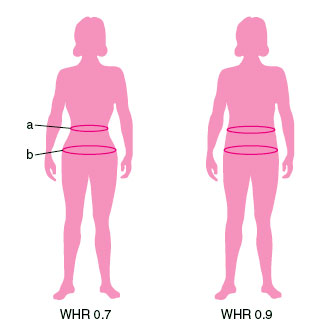 Figure 9: Waist/hip ratio
For a woman a WHR of around 0.7, is better than a high WHR, of 0.9 and over, in terms of health and fertility. In most cultures men will rate women with a 0.7 WHR as more attractive than a woman with a higher WHR. Popular evidence to support this is the fact is that present day catwalk supermodels, as well as film stars of the 1950s such as Marilyn Monroe and, going back even further, the famous (armless) statue of the Venus de Milo all have WHRs in the 0.7 range.
However body weight may be even more important than WHR in determining attractiveness and Swami and Furnham report on research that shows some variation among cultures when they looked at this measure. Generally, in economically developed societies men tend to prefer women with a lighter build, while men in economically developing societies tend to prefer a heavier build. These cultural differences are explained by evolutionary psychologists suggesting that in societies where food supplies were poor or uncertain it was understandable that women with a high body weight would be seen as better choice of partner. In economically developed societies these more basic considerations which are focused on survival in difficult environments are not relevant and other factors may come into play.
The evolutionary approach is controversial, with most psychologists viewing it as much too simplistic, but it does offer a wide-ranging explanatory framework within which to begin to understand and interpret human behaviour.
The work of Swami and Furnham above has introduced some of the cultural variation in what people consider to be attractive for potential intimate relationships. There are a range of other features that have been considered to influence attractiveness. Whereas signs of healthiness are most important, once these have been considered, signals of wealth or status may be taken into account. In the last few decades in western societies people have often valued suntanned skin and slimmer builds as this indicates someone has the resources to eat a healthy diet and take part in exercise as well as go on expensive holidays or at least to a tanning salon. Interestingly with the dangers of sun tanning being researched and publicised people with tans or at least sunburned skin are now viewed more negatively.
