by The Open University
Available in 36 free installments
Owner:
There are numerous examples, taken from different cultures, of more unusual physical adornments that have been considered to be attractive. In China the practice of female foot-binding was carried out for hundreds of years before being banned in 1911. The process was started when girls were about five years old and the ideal was to have feet no longer than four inches. As you can imagine this was an extremely painful process and girls and women were often unable to walk more than the shortest distance. This was a status symbol and only carried out on girls from wealthy families who would be expected to marry into a similarly wealthy family. Girls from poorer backgrounds would be expected to work, which would be impossible with bound feet. Similarly in Renaissance Europe women would often blacken their teeth to appear more attractive. The explanation for this is that sugar was only available to the very wealthy and sugar did cause teeth to rot and turn black so by painting your teeth black you could appear to be of high economic status and therefore a desirable person.
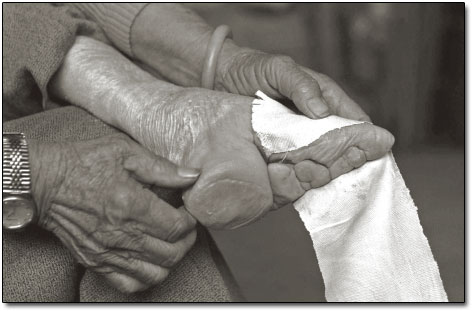 Rex FeaturesFigure 10: A bound foot
More recently, tattoos and skin piercing (currently popular in western societies) have become a must-have adornment for many people. These are just some examples of the kaleidoscopic range of body adornments that have been found to be attractive for different cultures. And there is the world-wide industry of male and female make-up, clothing design and cosmetic surgery that focuses so obviously on enhancing physical features. Our desire to establish intimate relationships will lead us to seek out certain people and present ourselves in the way that we feel will be most attractive to others. This in turn is shaped by the particular culture that we live in.
The emphasis our society places on physical attractiveness would suggest that each of us would seek long-term romantic relationships with the most attractive people we meet. But some of the research into relationship formation suggests that we are in fact more realistic and that we tend to form relationships with partners who are more of a physical ?match? to ourselves. This is called the matching hypothesis and has been supported by a number of studies. In one Bernard Murstein (1972) showed pictures of ninety-nine couples to participants. The pictures were separate so the participants could not know who paired with whom. Participants were asked to rate each picture for physical attractiveness. The scores for physical attractiveness of the real couples were much more similar than scores for randomly assigned couples.
This matching hypothesis does not contradict the previous view that we are attracted to people who are physically very attractive, but just highlights how, when it comes to actually making a choice, we temper ideals with a sense of realism. This process is sometimes explained in terms of costs and rewards. The costs of searching for a dream partner would be so high, if you consider the time needed and the likelihood of rejection if they are much more attractive than you are. Similarly people are not usually attracted to someone who is much less attractive than they are, because while the costs would be low, so would the rewards. Other psychologists suggest that, rather than being afraid of rejection, we are actually happier with someone more like ourselves, which ties in with what you were reading earlier about being attracted to people who are similar to us in all sorts of ways.
Think back to the information about schemas in Section 3.5. A schema is defined as a mental framework in which you would file all your knowledge about certain objects, situations, groups of people, even yourself. The view being suggested here on relationship formation suggests that people carry a mental schema that includes a set of characteristics that they would favour in a partner and that they seek out people who more or less conform to this. Research on schemas shows that factors other than appearance or physical attractiveness are seen as being more important when seeking a long-term partner. David Buss (1994), for example, studied unmarried college students in the US and found that the three top characteristics looked for in an ideal partner were: kind and understanding; exciting personality; and intelligent.
