by Wikibooks, open books for an open world
Available in 126 free installments
Owner:
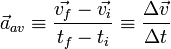 |
Acceleration answers the question "Is the object's velocity changing, and if so - how quickly?"
Once again we have an operational definition. We are told what steps to follow to calculate acceleration.
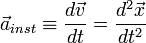
Again, also note that technically we have a definition for AVERAGE acceleration. As for displacement, if we are careful to use a series of small velocity changes, then we can write the definition for INSTANTANEOUS acceleration as
 |
Or with the help of calculus, we have ...
 |
